
Goodbye Decision Paralysis. Strategies for better Neurodivergent Decision Making.
Do you put off making decisions? Feel like you need to collect every single piece of information and evaluate every possible option before choosing? Do you second guess yourself or just worry that you need to combat your internal impulsivity?
Does all of this drain your energy far too much?
Today, I’m going to give you a simple strategy to stop decision paralysis from undermining your career.
If you’d prefer to watch instead of read, you can do so right here:
Why is Decision Making so Hard for Neurodivergent and 2e Individuals?
So I spend my time with people who are neurodivergent. Autistics who are incredibly detail oriented and need to analyse every possible outcome and ADHDers who know they’re often impulsive so are swinging too far the other way. Both have the same result: Drained energy and delayed decision making for fear of getting it wrong.
Both these scenarios lead to a big problem: a huge cognitive and executive function load. And it doesn’t go away when you “put it out of your brain”, it just external signals to everyone around you that you can’t make important strategic decisions. How do you expect your career to grow when you’re lacking this key skill?
And this doesn’t just happen to new managers by the way. It happens to senior leaders who are offered a new position who are not quite sure whether they want to go for it. Eventually the job passes them by, meaning not only have they missed out on a potential promotion, but also the other opportunities they could have pursued in this time instead.
Deciding not to decide yet is a decision in itself, one that leaves you stuck in a suboptimal status quo because that feels less painful than making the decision. I was going to say in reality you’re prioritising the short term at the expense of the long term but I don’t even think this is less painful in the short term. You’re in pain because you’re stuck.
All of this freezes neurodivergent careers, and because we can’t compartmentalise very well it takes over our personal life as well. This isn’t just a “fun quirk”, if you’re struggling with this you’re literally undermining yourself across the board.
So maybe it’s time to decide to fix this.
Want to see how well your decision making is performing at work?
Unlock your Neurodivergent Leadership Performance Score across the four domains that matter most for neurodivergent professionals: Strategic Conviction, Strategic Boundary Management, Strategic Decisiveness and Sustainable Capability.
I’m going to give you a solution now that sounds so simple but its simplicity is part of its brilliance. You need a meaningful person.
What conditions lead to better decision making in ADHDers?
This concept was identified in the paper Strategies for improving decision making of leaders with ADHD and without ADHD in combat military context.
I did a full break down of this study including the limitations and results in a previous post but the basic premise is this:
ADHDers make better decisions if they have a meaningful person to make that decision with.
The paper found this by taking a group of leaders, ADHD and non-ADHD, and putting them through a military decision making exam. The leaders took the exam in two parts, firstly all together in a classroom. This was to set a baseline for decision making performance. They then sorted the participants into four groups:
Groups 1 and 2: Taking the second half of the exam in the exact same conditions and in isolation respectively.
Group 3: In a room with a person who they had to tell their decision to. In this case the answers were hidden while the participant silently read the question. The examiner then uncovered the responses and the participant told their examiner their first and second-best choices.
Group 4: The same as group three but they had to wait twelve seconds before responding to try and combat ADHD impulsivity

I would like to present to you my latest hyperfixation, 3D modelling in blender, which I have used to illustrate the third and fourth scenario here.
Do you know what they found? The ADHDers had much wider variance. In all scenarios the best ADHDer performed better than the best neurotypical, but there was a much wider range in performances by ADHDers than non-ADHDers.
In the first two settings you can see this bear out directly. There was a slight improvement across the board from classroom exam setting to solitude but it didn’t really raise the floor for ADHDers and if you look at the average it’s not actually much higher. Some ADHDers found it very useful but that wasn’t universal. This combats the idea that just locking yourself in a room to focus is as universally valuable as society likes to preach that it is.
How ADHDers Can Overcome Decision Paralysis.
Now let’s look at group three and four to see the impact of a meaningful person and delayed responses. This was almost unbelievable to me and I had to double check I was understanding this properly when I read it: Every single ADHDer in groups 3 and 4 out performed every single neurotypical in the same group.
And it wasn’t even that these scenarios were worse for the neurotypicals. They didn’t score as highly as they did in solitude but they still did better than their classroom scores.The best performers in any one of these scenarios were the ADHDers in group three, the simple face to face scenario with a meaningful person.
The paper thinks the impulsivity combatting method might not have scored so well because the time was too short but I also have an opposing theory. They might not have performed so well because the ADHDers already worked out the best answer. We see that they answer better when there’s a meaningful person in the room. They then used the next twelve seconds to overthink and second-guess themselves entering this delayed decision making scenario I described at the beginning of this post.
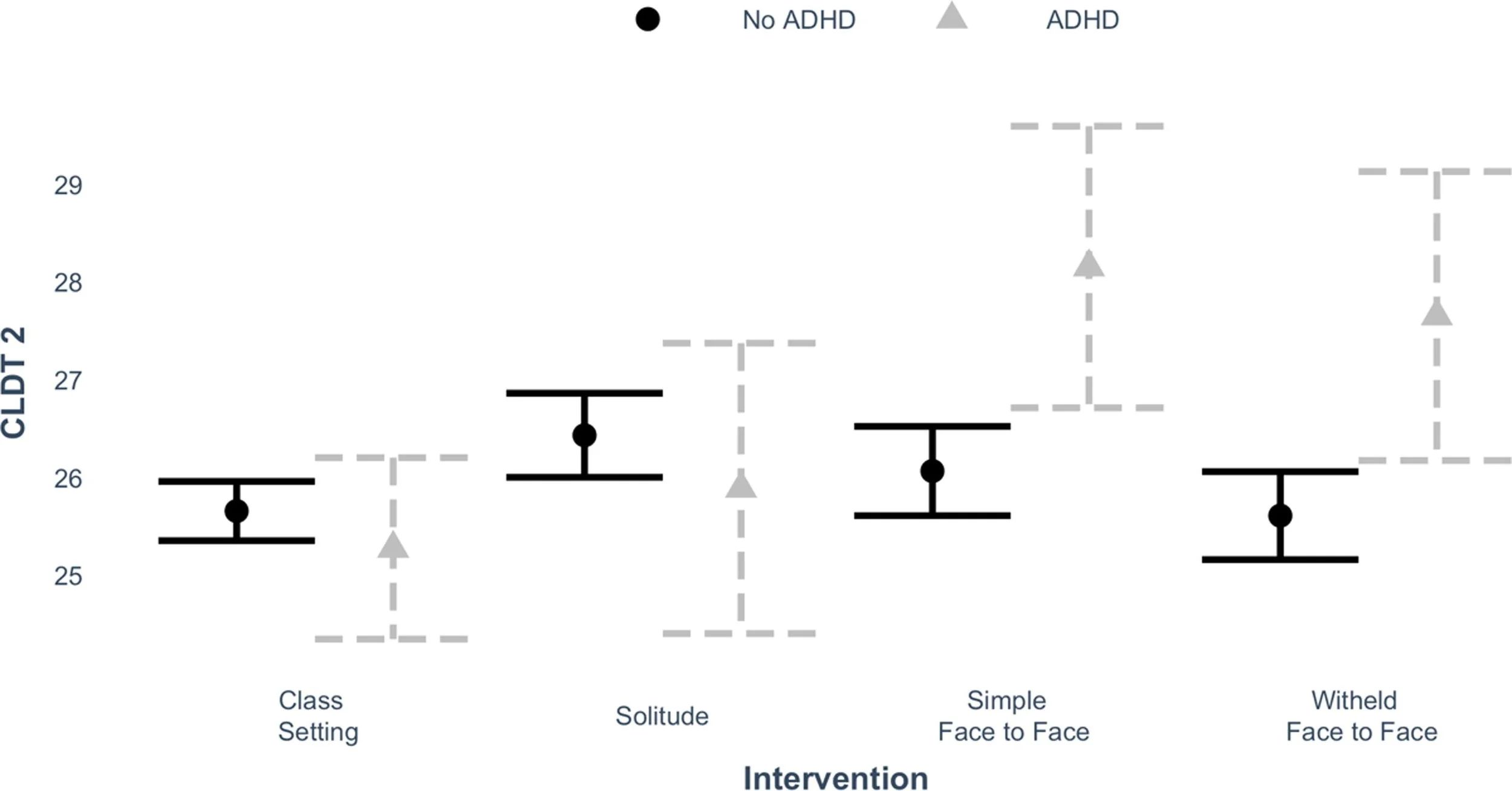
The decision making scores from the study, in which ADHDers in group 3 had the best decision making of all groups.
Which isn’t to say that ADHDers should just automatically trust their gut and go with their first impulsive decision, there are studies that indicate the opposite, but it is to say that they make significantly better decisions with a person to make them with. This is what the study dubs a meaningful person.
Why this helps with decision paralysis.
I have a few theories of why this works and it’s not about having someone to supervise you or any of that nonsense. For people who struggle with executive function, which includes ADHD, autism and other forms of neurodivergence as well, having a person in the room acts as a body double, vital accountability in the situation with you. If you’ve ever gone to a quiet coffee shop or coworking space to work because having those busy people around you is motivating then you already understand this concept intuitively. This is body doubling in action.
Because sometimes ADHD, and other executive function struggles aren’t about not being able to do the thing. It’s because we can’t get ourselves to do the thing. For most neurodivergent leaders, that struggle isn’t about something like hoovering. (By the way, secret, neurodivergent leaders are often paying someone to do that for them, I know I do). The struggle is things like making decisions. Things they know they should be good at because they’re highly capable yet struggle to do it anyway.
I think there’s also another secret power here the paper hasn’t unlocked but I think we can. My hypothesis is that neurodivergents make even better decisions if that meaningful person is also neurodivergent for one simple reason: They no longer need to mask.

I have many thoughts on masking, and I don’t necessarily think it’s a bad thing to mask in certain situations. But in a world in which we are often expected to mask, having someone to unmask with is incredibly valuable.
And I’ve played this role time and time again for my neurodivergent leadership coaching clients.
A client that was offered a role two levels more senior or redundancy took the redundancy because they realised they would have hated that job and this enabled them to choose something different.
A client coasting along in a kinda leadership position wasn’t really sure where they were heading. They decided to take ownership of their role, pitch what they wanted it to be and now are thriving in this new role which also came with a huge jump in seniority.
A client who put off decisions time and time again learned to start making them, and when they did they realised a key point: Most of their decisions were right. This gave them confidence to make decisions and built a virtuous cycle where they went from second guessing to confidently deciding. All in the space of the few months we worked together.
And I’m sure if you stop and think about it, you too have a story of a time you couldn’t make a decision, sat down with someone to talk about it and managed to find your way forward.
And honestly, the realisations I’ve laid out to you here are why I think the coaching I do is so valuable. I’m a neurodivergent leader who has to make hard decisions and when I do, I seek out a person who I can trust, who I don’t need to mask with and use them to be my meaningful person.
I can be that person for you too. And even better, I bring three and a half years of experience coaching neurodivergent leaders with me as well. Hit the link to find out exactly what neurodivergent leadership coaching can do for you.
Ready to Define Leadership on Your Terms?
If you’re ready to stop trying to fit into someone else’s leadership mold and start building confidence your way, I’d love to help. Book a Neurodivergent Leadership Coaching Call or Explore more leadership transformations here.
Leadership doesn’t need to look “normal” to be powerful. It just needs to look like you.
Want to see more?
Sign up with your email address to receive the latest thoughts on neurodivergent careers and leadership.